
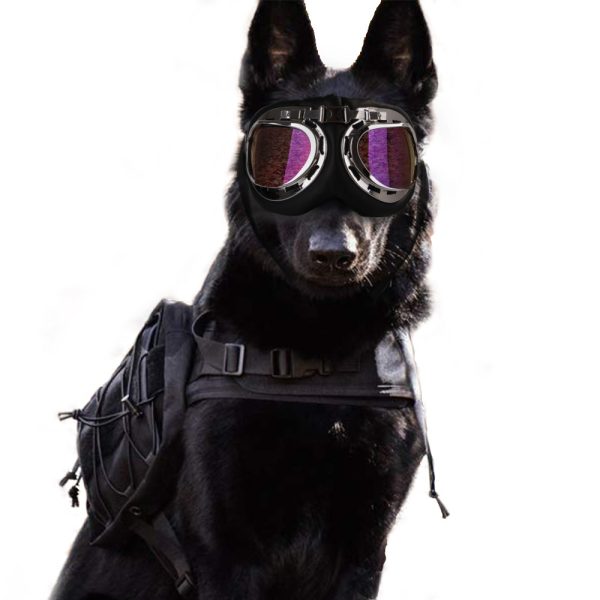
How to choose pet glasses
I. Core Premise: Under what circumstances do pets need glasses?
Medical protection: After surgery and during the recovery period of eye diseases (such as corneal ulcers), prevent scratching and infection.
Environmental protection
Travel: When taking a vehicle, prevent wind, sand, dust and flying insects from getting into your eyes.
Outdoor activities: Protect against tree branches and ultraviolet rays when cycling or hiking.
Specific activities: swimming (to prevent pool water), beach play (to prevent sand), snow (to prevent snow blindness).
Working dog requirements: Professional protection is needed when performing special tasks (such as search and rescue, working in a gravel environment).
Note: If it is only for taking photos and dressing up, please choose a fun decorative frame without lenses and without a sense of restraint, and only use it for a short time under the close supervision of the owner.
Five Golden Rules for Choosing Pet Glasses
Principle One: Safety materials are the bottom line
Lenses: They must be made of shatter-resistant and non-toxic polycarbonate material, which will not break and hurt the eyes even when impacted. Absolutely avoid glass or hard plastic.
Frame and straps: Made of soft, elastic and non-toxic silicone or soft TPU material. The parts in contact with the skin must be smooth and free of burrs.
Overall: There are no small parts that are easy to fall off and can be swallowed.
Principle Two: Fit and comfort are key
Three-dimensional fit: Good goggles should be designed in 3D based on the facial contours of dogs or cats, just like masks, rather than being flat.
Key contact points
At the bridge of the nose: There is a soft pad that does not press on the bridge of the nose.
Around the eye socket: There is a soft sealing ring that fits closely but does not press on the eyeball.
Strap system: It is usually fixed at three points (behind the head, under the neck), which is more stable and less likely to fall off than the two-point type. The straps should be wide and soft to disperse the pressure.
Weight: It must be extremely light and not cause any burden when worn for a long time.
Principle Three: Both vision and ventilation are indispensable
Field of view: The curvature of the lens should provide a wide peripheral field of view without affecting the pet’s normal observation of the world.
Ventilation: There must be insect-proof ventilation holes to prevent fogging of the lenses and ensure air circulation. This is the key to comfortable wearing, especially in hot weather.
Principle Four: Strong functional targeting
Ultraviolet protection: Essential for outdoor activities. Choose lenses marked with UV400 protection.
Waterproof/sealing property: Required when swimming or working underwater.
Lens color
Transparent/Yellow: On cloudy days, at night or indoors, enhance contrast.
Smoke grey/colored: On sunny days, it reduces the glare from strong light.
Criterion Five: Adjustability and ease of use
Multiple adjustments: The head circumference, neck circumference, and the bridge of the nose should all be fine-tuned to achieve a tailor-made effect.
Easy to wear: The design should enable the owner to put it on the pet easily and quickly, avoiding long struggles.
Iii. Step-by-step selection process
Precise measurement: Use a flexible tape measure to measure the pet’s head circumference (the maximum part), face width (between the outer sides of the eyes), and nose bridge length (from between the eyes to the tip of the nose). Select according to the product size table.
Choose professional brands: Give priority to well-known professional pet goggles brands such as Rex Specs and Doggles, which offer more guarantees in terms of safety, design and ventilation.
Physical sample fitting (if possible) :
Let the pet be in a familiar and relaxing environment.
Observe signs of discomfort: frequent head shaking, scratching with feet, trying to rub off, becoming agitated.
Check: Can you blink freely? Is your breathing smooth? Is the field of vision significantly obstructed?
Progressive adaptation: Don’t expect your pet to accept it immediately. Start with a short period of wearing, accompanied by a large number of snack rewards and praises, and gradually extend the time.
Iv. Important Precautions and Warnings
Do not force: If the pet shows extreme fear or stress, stop using it and consider other protection options (such as a car pet windscreen).
Not all pets are suitable: Short-nosed dogs (such as French Bulldogs and pugs) are hard to find a suitable style due to their special facial structure, and they are more prone to breathing difficulties.
Medical use must follow the doctor’s advice: If it is for postoperative protection, the specific style and usage duration must be consulted with a veterinarian.
Cleaning: After use, clean with clean water and a soft cloth. Avoid using irritating chemicals.
Summary: Put the feelings of your pets first
Choosing glasses for a pet is essentially choosing a safe, comfortable “armor” for it that does not interfere with its normal life. Its core value lies in preventing harm rather than being “good-looking” from a human perspective.
The most successful pet glasses are those that make pets almost forget their existence after wearing them, yet they can explore a broader world with peace of mind.